Languages & Communication · · 7 min read
Why Does Spanish Sound Faster Than English?
The science behind speech tempo, information density, and what changes during bilingual video calls.
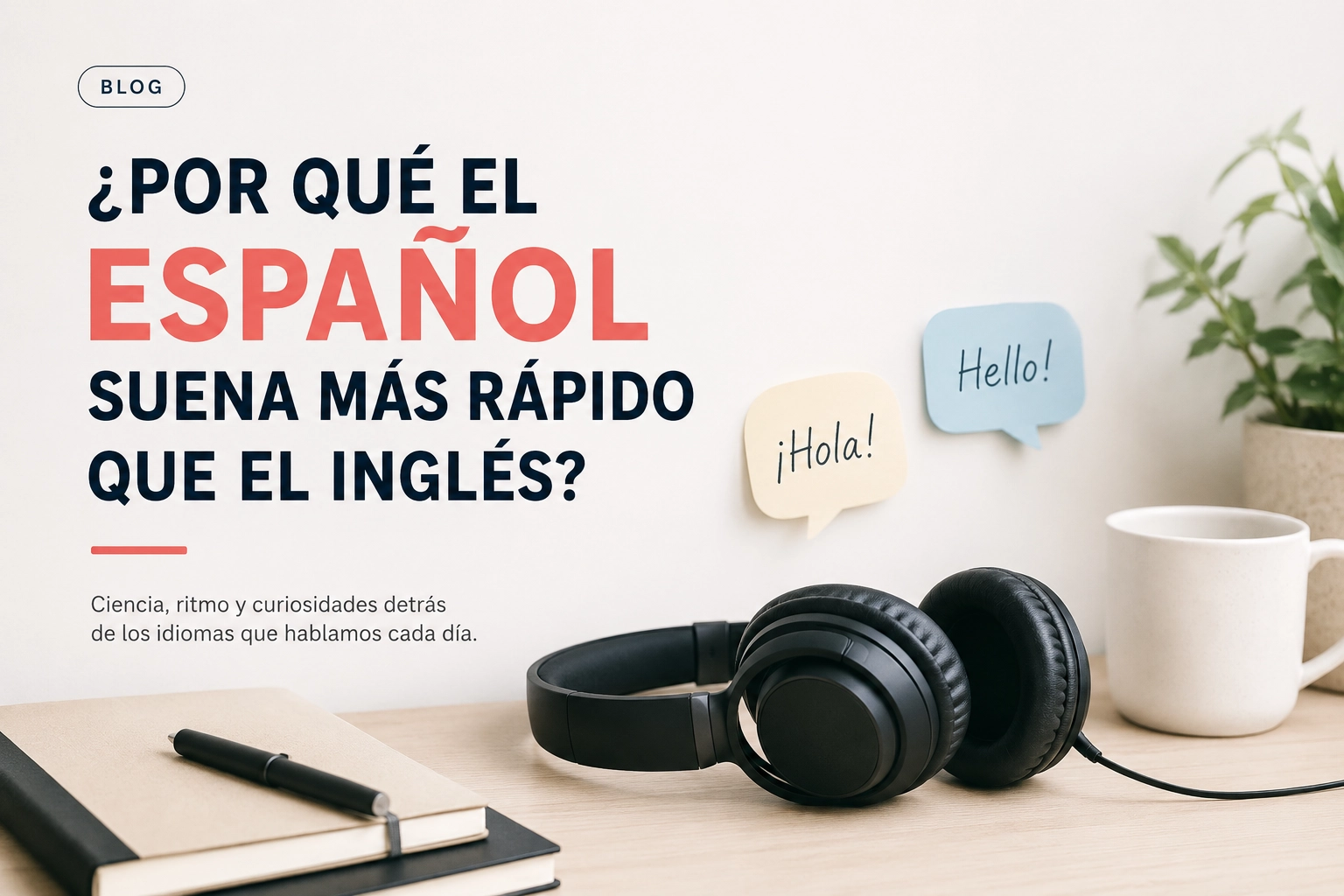
To many English speakers, Spanish sounds extraordinarily fast. Conversely, many native Spanish speakers feel the exact same disorientation when listening to rapid spoken English. This sensation has a solid linguistic explanation—yet it does not mean that one community speaks "better" or that another speaks "slower".
Syllables Per Second vs. Words Per Minute
Linguistic research shows that Spanish speakers generally articulate more syllables per second than English speakers (around 7.8 syllables/sec compared to approximately 6.2). However, syllables in English tend to carry a higher amount of information per syllable. Human languages naturally balance articulation speed with information density: a language may sound faster, yet transmit a comparable amount of conceptual content over the same amount of time.
Why Regional Accents Can Sound Even Faster
Beyond the core language, accents, intonation curves, cadence, and the listener's familiarity play a crucial role. For example, Rioplatense Spanish (spoken in Argentina and Uruguay) has an Italian-influenced musical cadence where words often blend seamlessly together through elision, making it feel especially rapid to the unaccustomed ear.
What Changes in a Bilingual Video Call?
In a cross-border meeting with multiple spoken languages, software cannot just transcribe words—it must decipher conversational turns, natural micro-pauses, regional accents, and pragmatic context simultaneously. A misdetected pause could prematurely cut off a thought, while a word recognized out of context can completely alter business intent.
Why Technology Needs to Do More Than Literal Translation
A great real-time translation experience requires attentive listening, speaker diarization, and returning speech without disrupting the organic rhythm of the dialogue. This is why ultra-low latency, intelligent pause detection, and natural vocal inflections are just as critical as raw translation accuracy.
Key Takeaway
Spanish isn't inherently "faster" than English—it simply packages cadence and meaning differently. Understanding this linguistic balance is essential to engineering next-generation video meeting tools, where hearing the nuances is just as important as translating the words.